
“Russia does not hold back - they shoot, and shoot down drones all night”: 7 days in Ukraine.
The Russian government has maintained a persistent line that Ukraine needs to be ‘De-Nazified’ since its invasion began in 2022, and according to Sergey Naryshkin, head of Russia’s foreign intelligence service, it is a “failed country”. So, I travelled to Lviv, Kyiv & Sumy to meet Ukrainians and see for myself.
After I arrived with the aid group Ukrainian Action in Lviv on a bleak, dark, and cold early morning during the curfew on the 29th of September, I had no idea what to expect from this country. So far, my experience had been waiting several hours for the slow cogs of bureaucracy and paperwork stamping to finish before we could enter Ukraine, and then hallucinating statues of the Virgin Mary before slumping into my hotel bed after being awake for nearly 40 hours. It was a tough journey. Thankfully, many staff at my hotel spoke good English, which made life a lot easier, although I felt bad for them when I was fatigued. I doubt I made much sense, especially when filling out my check-in form. I proved that if spoken words can slur, written words can too.
Lviv is a unique city that has had a shared history of ownership, or occupation, from multiple countries, including Austria, Poland, Nazi Germany & the Soviet Union, before eventually returning to an independent Ukraine in 1991, so it was no surprise its architecture felt like what my mind would paint of an old and grand Eastern European city. There are few ‘obvious’ signs of war here, Lviv is very far to the west of Ukraine, and attacks are infrequent, making it somewhat of a safe haven for those fleeing the more dangerous cities and towns. However, that is not to say the signs aren’t there.
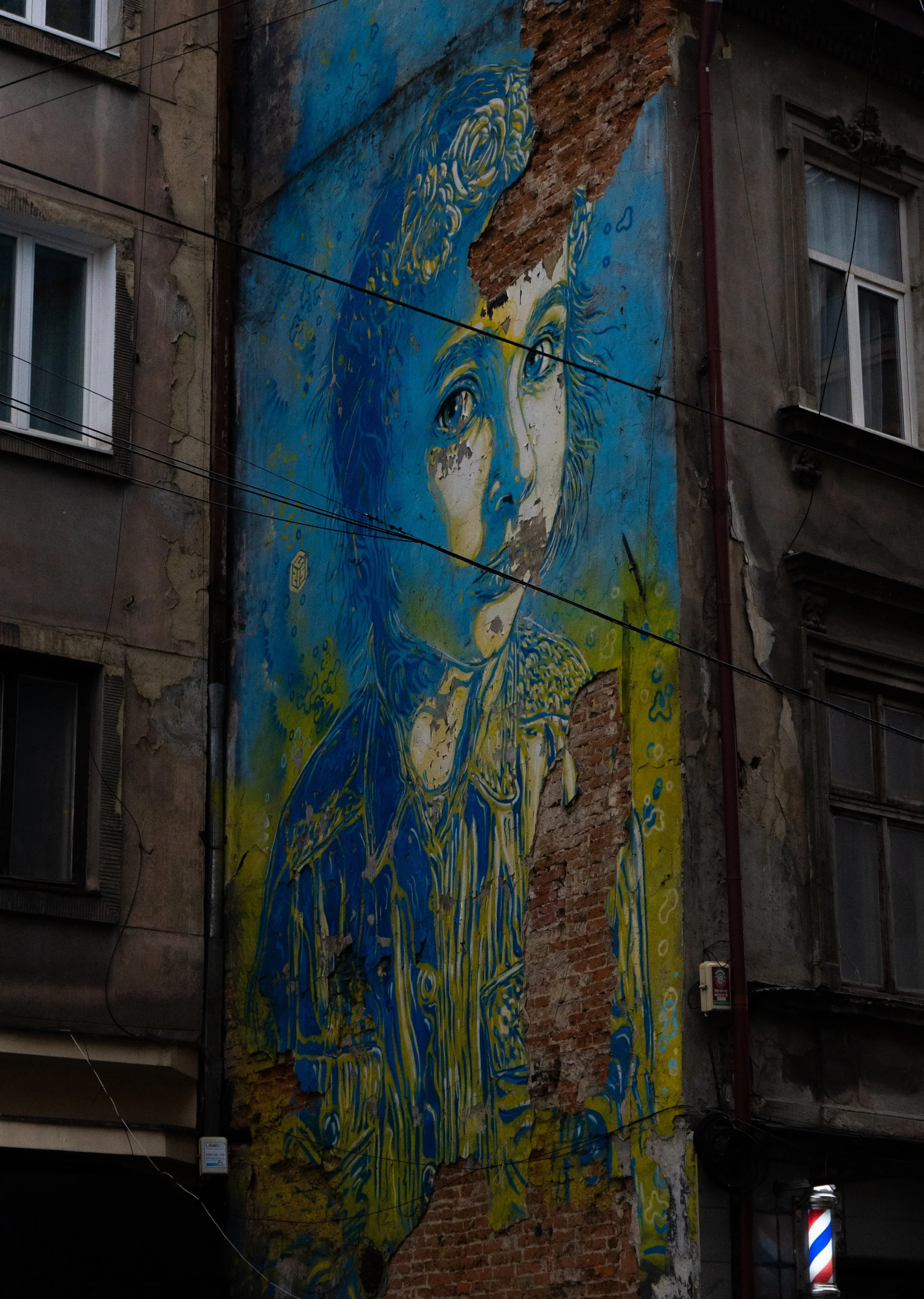
29 September, 2025 - Lviv, Lviv Oblast, Ukraine: A damaged mural of a child in Ukrainian colours stares at those coming down the street. It was beautiful to see, yet its damage was a haunting reminder of where Ukraine is in its modern history and the uphill battle it faces for its future.
After walking about the city for a while in the rain, I felt it was a good time for food, and I found a lovely place called the Winston Churchill Pub, with the namesake having a huge portrait on a wall all to himself. Upon entering he pub, I was immediately struck by the wall of military unit patches and foreign currency pinned to the beams from those who have travelled through here like I have. I also couldn’t help but notice the diesel generator by the door in case of a power outage. Even though some cities are targeted less than others, the Russian military tends to concentrate attacks on Ukrainian power infrastructure the closer it gets to winter - so a city may not be directly hit, but its power could be off for days. After a good meal, I wrote a personal message on a £10 note and had it stuck to the bar and went on my way.
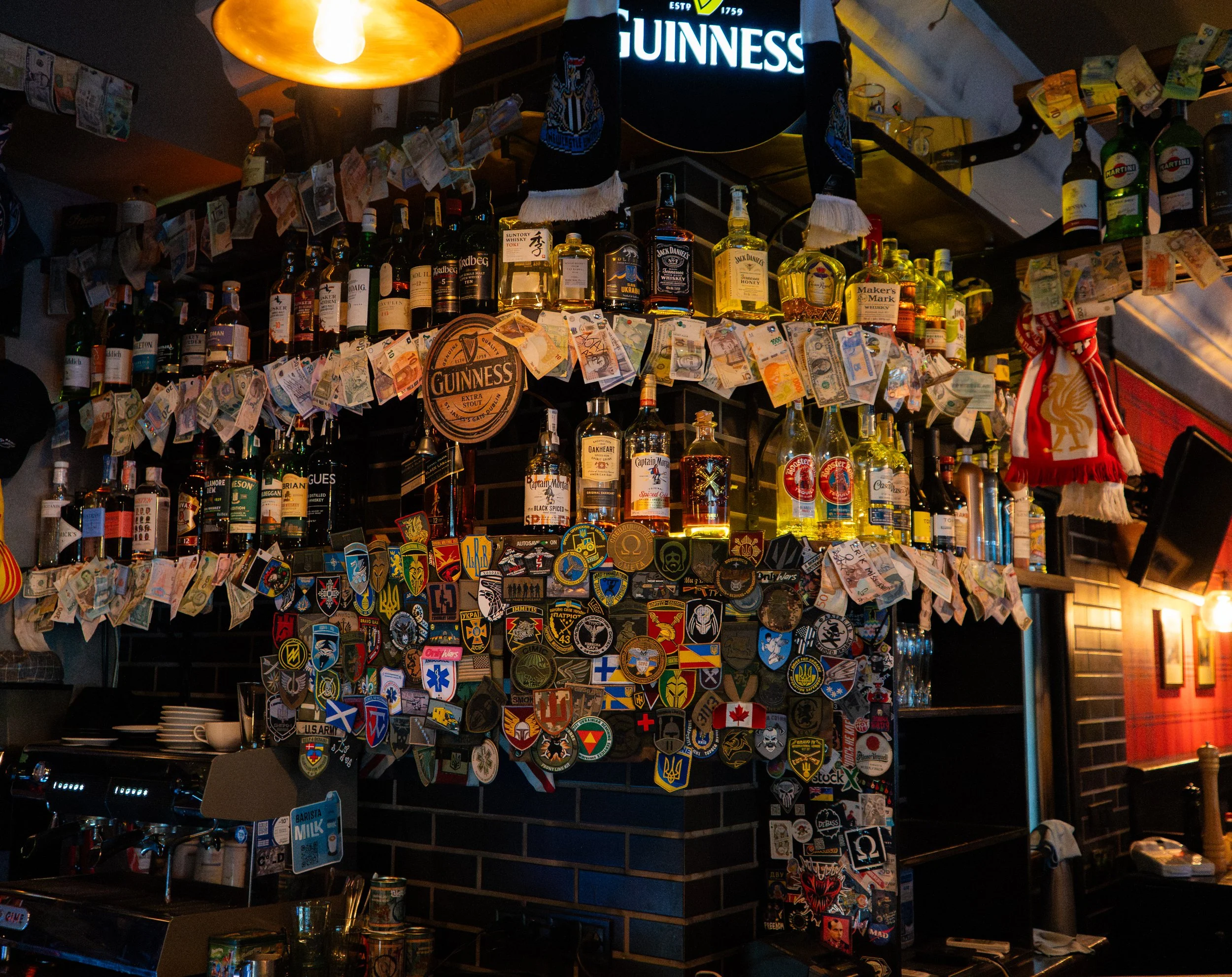
29 September, 2025 - The Winston Churchill Pub, Lviv, Lviv Oblast, Ukraine: The bar is decorated with unit and other morale patches, as well as foreign currency, some with personal messages on them. In the bottom left I noticed an Azov unit patch with a wolfsangel rune, a reminder that even though Putins claims are broad and unfounded, Ukraine has had an identity issue with a select few of its military units for use of Nazi insignia. Many Azov units, though, such as the famous ‘3rd Brigade’, have since rebranded to remove such runes from their logo, but the old design is still occasionally found.
Walking around Lviv was odd; the city itself was remarkably safe and well run, with many cafes, bars and restaurants operating without worry, however, the smaller signs of a faraway war were still there. The generator in the pub, off-duty soldiers everywhere - some with awful injuries, and the nightly 12 am-5 am curfew. One prominent reminder of the war is the many recruiting adverts for specific military units, some with very modern branding, and also similar recruitment efforts for FPV drone pilots were everywhere; shops, bus stops, even on some payment machines.
Back at the hotel, I spoke with a waiter, whose name I will anonymise as Andriy, and he told me how 20 years ago, he would drive Russian tourists around in a taxi for a living, and the tourists would see them (Ukrainians) as regular, normal people. Now he believes it is completely different due to propaganda. He remarked that even though he does not trust his government 100%, he knows who Ukrainians are as a culture and a people, and what is coming out of Russia is false and not true. Whilst Andriy lives in arguably one of the most peaceful cities in his country during wartime, I could still sense there was a deep frustration and sadness, that those people who were once joyful tourists who saw Ukraine as a free state of normal people, could potentially now be towing the Kremlin line that Ukraine is a failed nation that needs denazifying. Nothing I saw in Lviv made me feel unsafe or that I was in a ‘failed state’, and Andriy’s honesty and lack of fear to speak his opinion, even about his own government, told me this is hardly the country the Russian Federation wants to convince people it is.
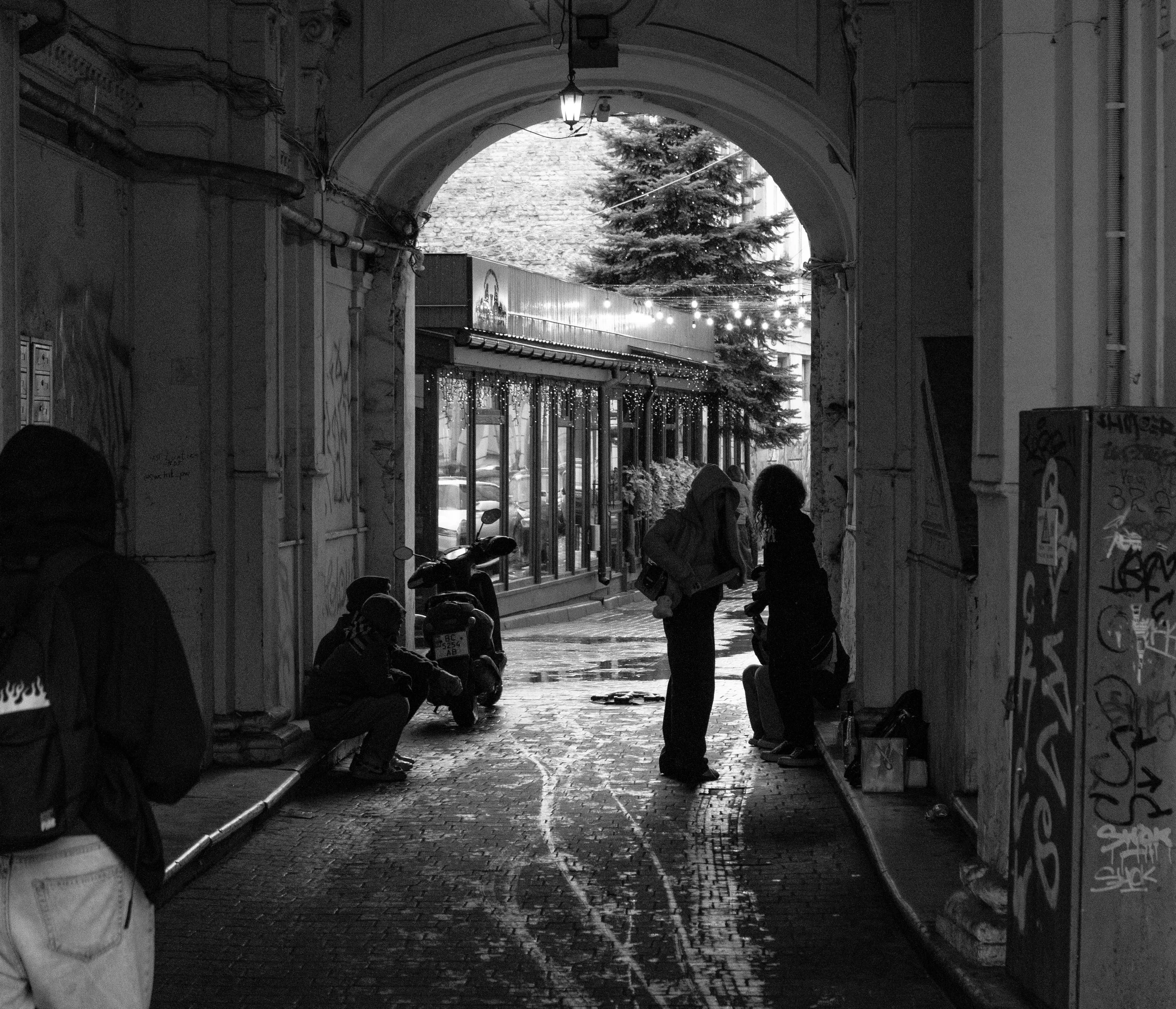
29 September, 2025 - Lviv, Lviv Oblast, Ukraine: Young people hang out in alleyway near a resteraunt. In my time there, Lviv was a very vibrant city full of young faces going about their lives.
The taxi drive on my final day in Lviv was another reminder I wasn’t at home anymore; all the seatbelts in my taxi were broken, and the driver had his off. This would be a common recurrence for me in Ukraine. In some ways, I thought “there’s a war on!” so I understood, but the way they drive here didn’t exactly inspire confidence. At this point, I had more worry about dying in a car crash than being hit by a drone or a missile.
After making it to Lviv train station my hopes of seeing its grand entrance hall were dashed, as it was blocked by security services, with some 50 people waiting to get in. I couldn’t figure out what was going on, so I found a side entrance to the tunnels underneath the station that led to the platforms and patiently waited for my train, which would be delayed by an hour. Lviv station was cold and bleak, the electronic board crackling as it switched between Cyrillic and English. Finding my train was a breeze, but waiting in the cold was not. Big old Soviet-era diesel trains rolled past now and then, shaking the earth as they did. Looking outside the station, I could peek into a cargo area and saw a transport train roll in with what looked like a U.S.-made Navistar MaxxPro MRAP (Mine Resistant Ambush Protected vehicle), a large armoured truck designed to move troops quickly and with decent protection. Turning around, a large sleeper train, also going to Kyiv, had pulled in and was being serviced. An attendant wearing a poncho over his uniform smoked a cigarette next to a hose secured to the train, which was leaking some fluid as he paced up and down. I was praying it wasn’t gasoline.
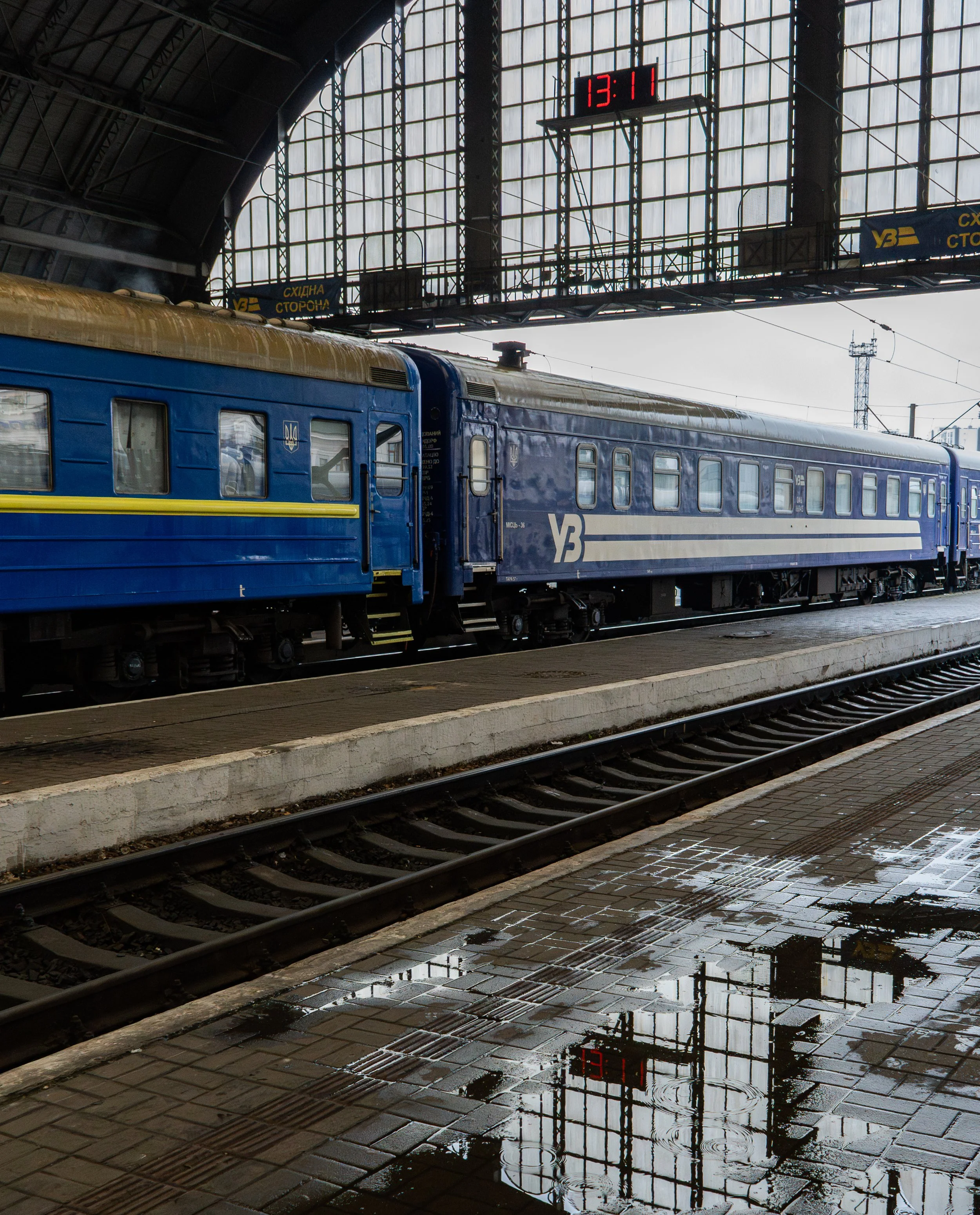
30 September, 2025 - Lviv, Lviv Oblast, Ukraine. A train waits at a platform in Lviv train station on a cold and cloudy day.
From where I’m standing, I can see through the undercarriage of the train, and a child is climbing down onto the track. Within seconds, the arm of their mother shoots into view and grabs them by the coat, yanking them back onto the platform with a small slap on the back. Everyone seemed very unbothered. Shortly afterwards, our train pulls in, and it’s time to go to Kyiv. I am lucky to be seated next to a kind man called Marko, who spoke good English, and he offered to interpret for me for anything I needed, which was greatly appreciated. Marko is in IT and spent much of the ride working while I continued writing notes. As the Ukrainian countryside flies past us, it soon becomes night, and several hours later, we pull into Kyiv. I give Marko a handshake and say goodbye, and make my way to my hotel. It is dark, but everything seems to be functioning like normal here, which was to be expected. There is this unusual idea people paint in their heads of what a country at war is like, in that it is rubble everywhere, regardless of where the front line is but that is not the case.
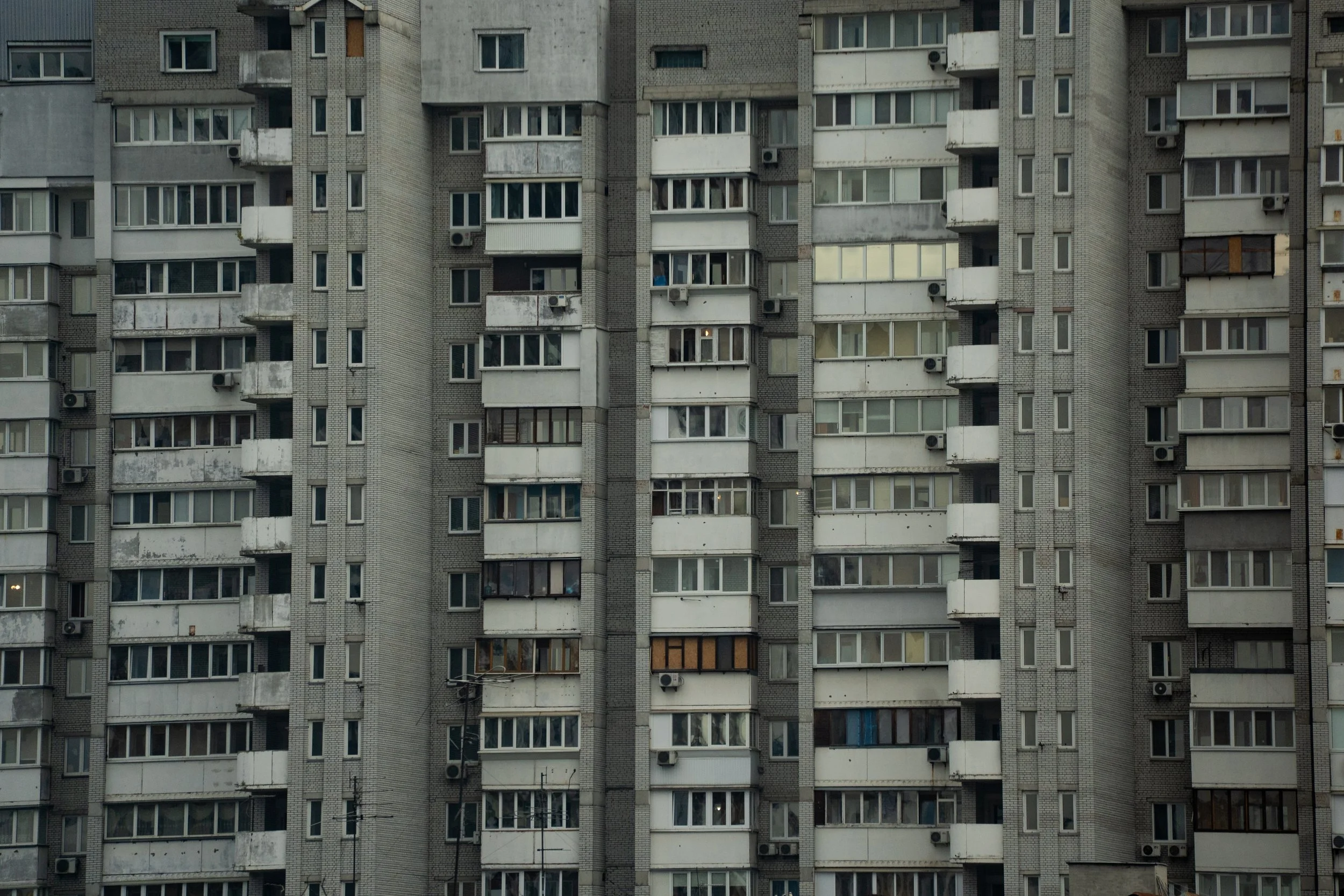
01 October, 2025 - Kyiv, Kyiv Oblast, Ukraine: The sight from my hotel room of large looming apartment buildings. Such buildings are frequently struck by Russian drones and missiles during air raids.
It did not take long to fall asleep, as the night was peaceful, but I was very quickly reminded where I was when the first air raid alarm I’d experienced happened whilst going down for breakfast. It’s a bizarre feeling, hearing it blare across a city in daytime; most people continue to go about their business, very aware of the risks, but refusing to live in fear. The alarm quickly passed, but the warning remained. After breakfast, I was soon out and about in Kyiv, on my way to Maidan Square in yet another taxi without seatbelts.
The feeling of Maidan Square is a surreal one. You are immediately greeted by the Independence Monument, a towering statue of a woman holding a guelder-rose branch. It was built in 2001 to commemorate 10 years of Ukraine’s independence from the Soviet Union. As I wait around, I take a moment to walk around the memorial that is on one side of the square. It was an overwhelming feeling, seeing so many faces and so many flags, fighting for a conflict so far from where I have lived my whole life and yet so close to me as a European. Seeing it in person made me wonder only one thing: how have we allowed millions to die for our security and done so little to help? It bothered me immensely.
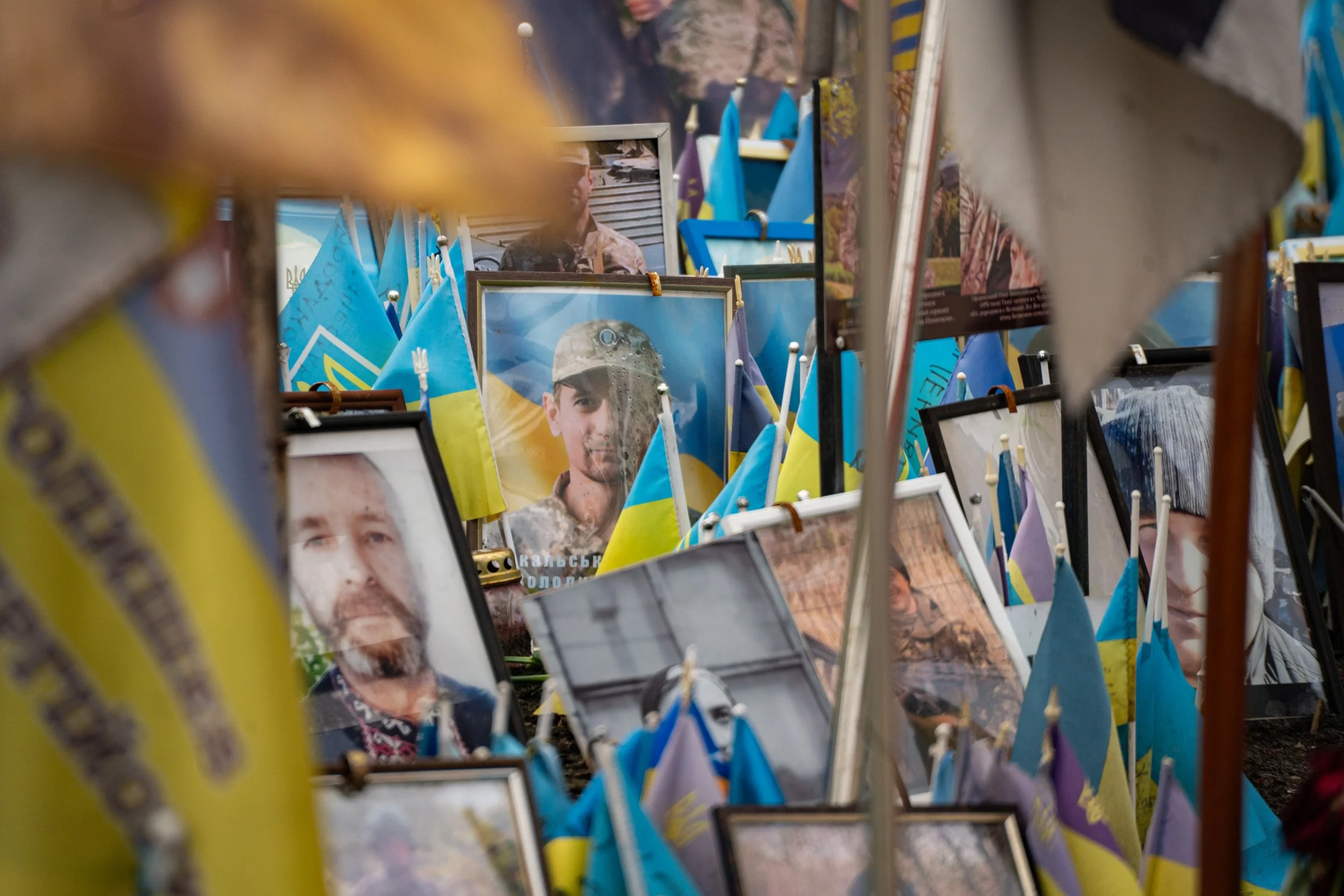
01 October, 2025 - Kyiv, Kyiv Oblast, Ukraine: Some of the many faces and flags of those lost. There are hundreds, if not thousands, across the square, all placed and managed by everyday citizens.
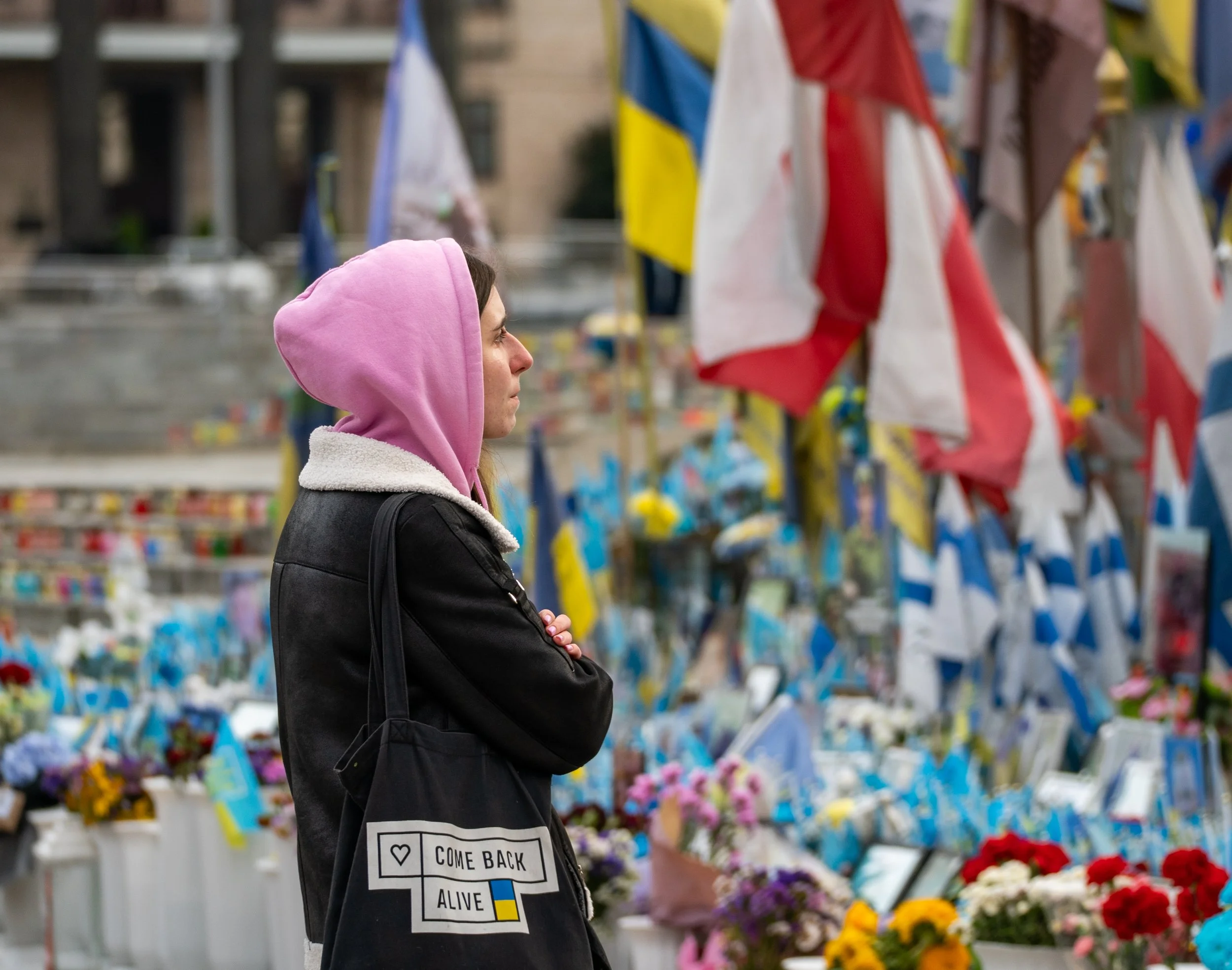
01 October, 2025 - Kyiv, Kyiv Oblast, Ukraine: A woman fights tears as she pays her respects at the memorial in Independence Square.
I notice people beginning to exit the Kyiv metro holding placards, and some arrive in taxis. It soon becomes clear they are gathering here for a demonstration. Many are women, holding pictures of their lost loved ones who had died on the front. The group soon swelled in number, many faces with wounded expressions holding signs asking for a minute’s silence and for people to remember those lost in the defence of Ukraine. Very soon, the demonstrators moved out into the street as police officers stopped traffic, and a minute’s silence was observed. It was clear many of those holding placards were wounded in their own way, lost husbands, sons, sisters. Many held strong faces, and many wept. The sense of loss is overwhelming, especially knowing the estimated Ukrainian casualties since the start of the conflict. In that moment, I thought to myself how this feeling must be everywhere, and in everyone, in some way or another. It was inescapable.
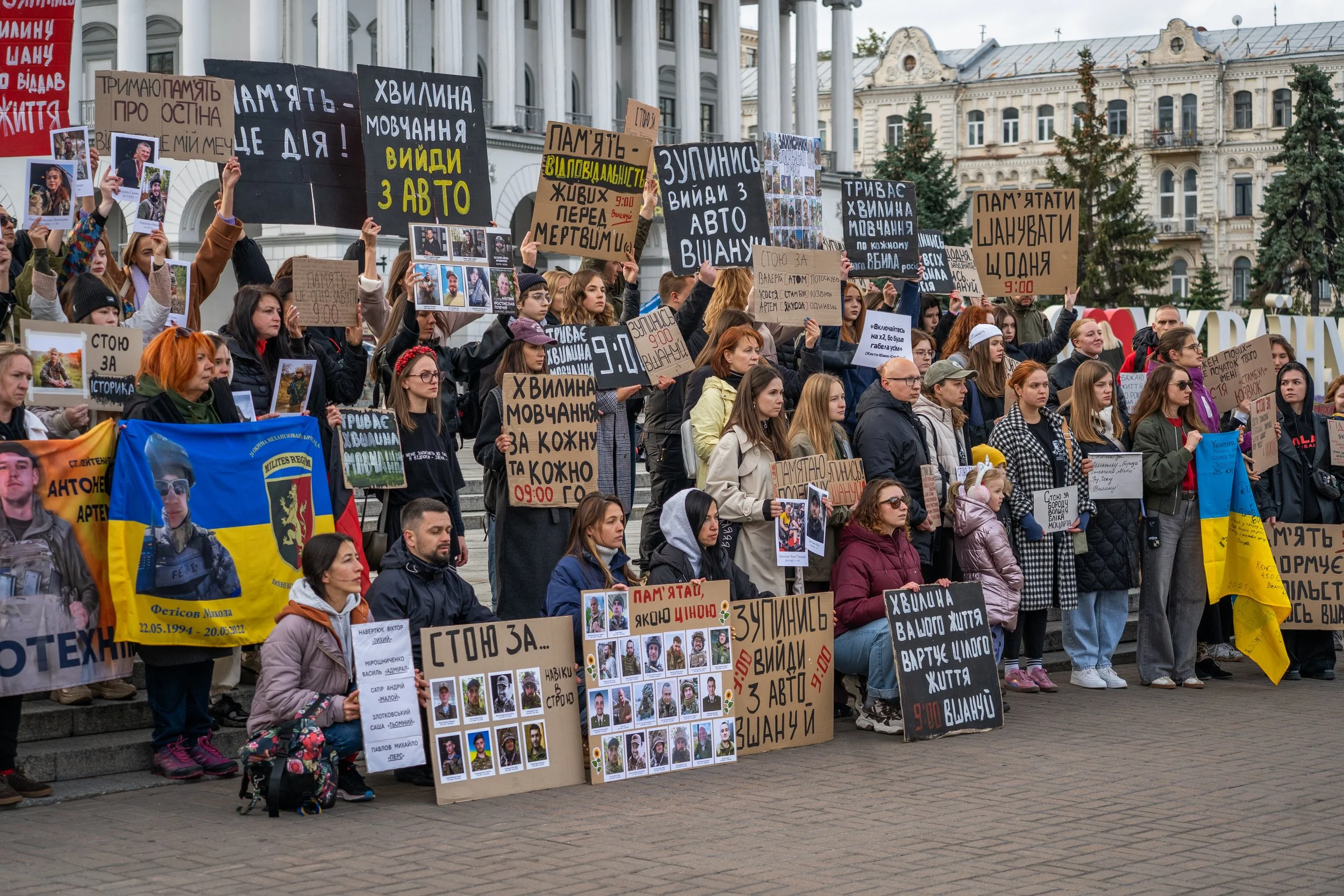
01 October, 2025 - Kyiv, Kyiv Oblast, Ukraine: Demonstrators pose for a photo, showing photos of those lost and placards calling for remembrance.
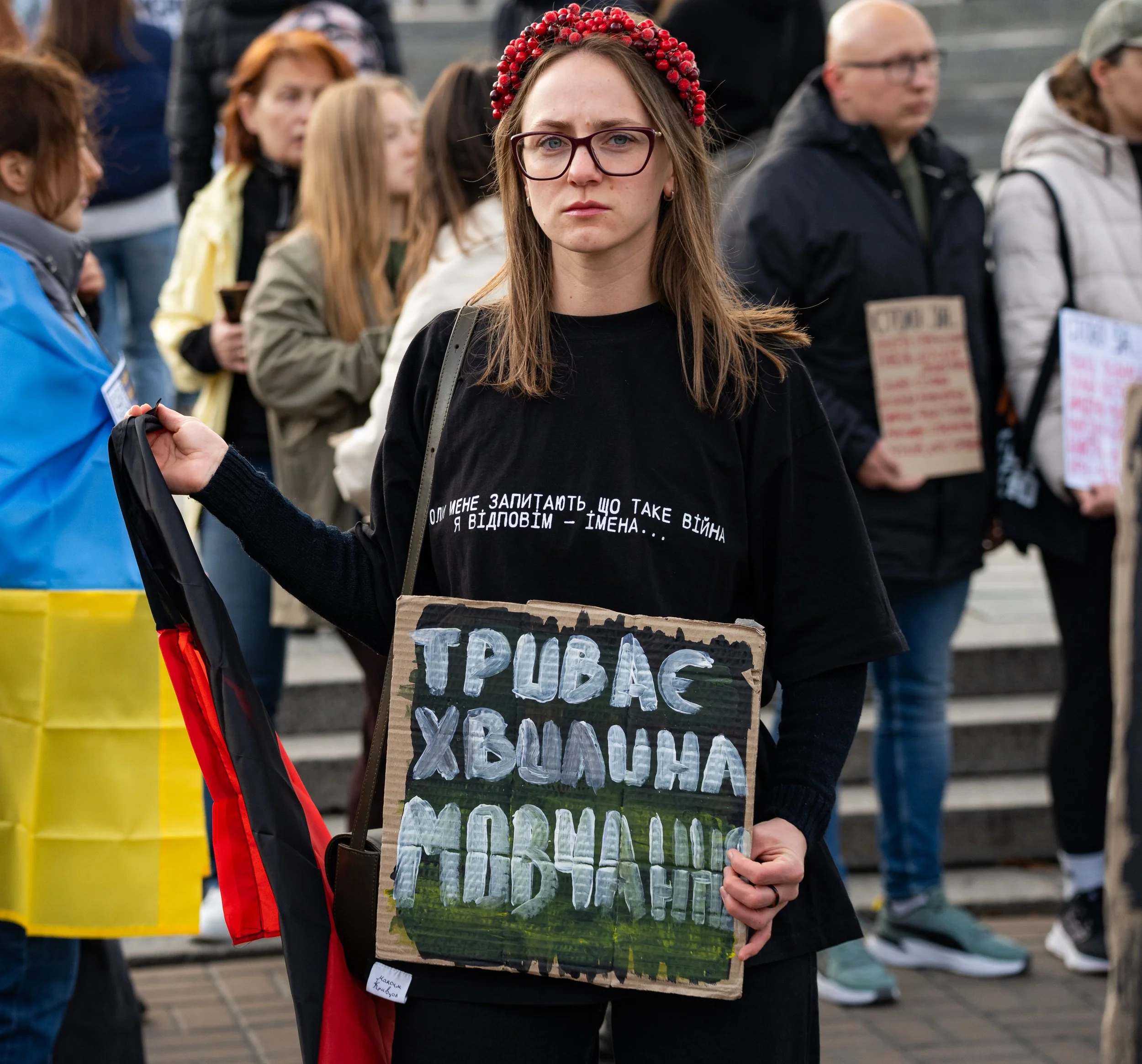
01 October, 2025 - Kyiv, Kyiv Oblast, Ukraine: A demonstrator poses for a photo with her placard calling for respect for a minute’s silence.
After leaving the demonstration, I visited some military surplus stores outside Kyiv train station. In any other country, it would not be an interesting thing to visit; however, it is hard to ignore why there were five of them next to each other. When I entered, I realised very quickly that this is nothing like the surplus stores we see elsewhere, particularly in Britain. Wall to wall, it was full of modern chest rigs, armour, helmets, plate inserts, ammo pouches and all kinds of other gear. None of this was vintage or being resold; it was all new. I got talking to Oleksandr, who works at the store, and asked him about the gear and why there were so many of these shops. He told me that it was common for soldiers to come and buy gear for themselves if they didn’t fancy their issued kit, or if they wanted something newer. Oleksandr then told me that the person who owns this particular store actually serves on the front as a Sergeant, and tests a lot of the gear they produce. It was a very surreal experience. To put it into perspective for those back in the UK, imagine seeing serving soldiers coming back from Afghanistan in the 2010s and buying themselves entirely new sets of armour, helmets, whatever they liked, rather than their issued kit.
On my last night in Kyiv, I finish editing some photos and head to bed. I am reading about Russian attacks on Ukrainian rail lines and logistics between here and Sumy, my next destination, which fills me with worry; however, my gut is still telling me all is good. It is never easy weighing up risks, but when it comes to something so important to you, it has to be done realistically and without bias, which isn’t an easy thing. Another air raid alarm during the night, but it didn’t disturb my sleep too much. Fast forward several hours, and I’m about to hop on a rickety old ex-Soviet train. Very, very different to the one I arrived in Kyiv on, but it’s to be expected on a lesser-used line such as this. During the journey and after some more editing, the travel fatigue is beginning to hit. It’s a big country, and as this rickety train barrels past the Ukrainian countryside, I’m telling myself next time I won’t visit so many different cities in such a short span of time, and maybe take a holiday somewhere peaceful, but such thoughts are quickly replaced with the fact that I have that luxury; many around me do not.
Arriving in Sumy was like arriving on a different planet. I felt very restricted in taking photos at this point because it’s a frontline city. It was freezing, pouring down with rain and foggy. I had to hop down off the train due to the platform height difference, and then cross the open track to get to the station. All around me, there are soldiers armed with automatic weapons, many with faces covered and some with ponchos, staring at those disembarking. It is quite an intimidating sight, and very different to Lviv and Kyiv. The troops are conducting spot checks and checking IDs for people coming into Sumy, but somehow, despite my appearance, I passed freely. After a quick cigarillo to keep warm and a taxi to the hotel, and spent my first night 16 miles away from the deadliest war in Europe since World War 2. It was not easy, but eventually I fell asleep to the occasional sound of anti-aircraft fire as Shahed drones buzzed overhead. From my research the following day, it turned out that this was actually a quiet period for the city.
02 October, 2025 - Sumy City, Sumy Oblast, Ukraine: Anti-Aircraft fire echoes through the sky near my hotel as they attempt to shoot down Shahed OWA (one way attack) drones.
I’d been at the hotel less than 12 hours and already experienced more air raid alerts than my entire time in Kyiv. English was even less common here, too, which led to some fun difficulties with the receptionist where I was staying, but Google Translate is a very nifty tool. Sumy carries a lot of ex-Soviet brutalism in its architecture, and in October, it is certainly not the most beautiful place in the world, but it’s still what some call home, which is a privilege in and of itself to witness its citizens going about their daily lives with such composure in these difficult and uncertain times. As mentioned before, I did not take many photos in Sumy, as I had no accreditation and getting arrested for espionage was not something I wanted. Military vehicles and small groups of soldiers were everywhere, and I had no interest in disturbing them.
What stuck out to me was that the military presence here in Sumy was very relaxed, besides the occasional armed personnel like at the train station, many were small groups of men, often no more than 4, travelling together in civilian vehicles spraypainted in camo patterns and rudimentary welding of anti-drone cages around the windows, and anti-drone jammers on their roofs. Some of these soldiers seemed to be unwinding, some seemed to be preparing. I distinctly remember waiting at a crosswalk and a dingy yellow car driving past with four big Ukrainian soldiers huddled in it, chomping on beef sticks. Just outside my hotel, there was also a Mercedes ambulance very similar in design to one I drove into the country with Ukrainian Action, camouflaged in olive green. After wandering around Sumy for a few hours and feeling very confused when eating at a New York pizza restaurant, I returned to my hotel for another night of buzzing drones and anti-aircraft fire.
On my last day in Sumy, the weather was extremely nice, the sun was already setting low, and there was a lovely orange warmth to everything. In this moment, Sumy actually looked quite charming compared to when I’d arrived. I decided to make the most of the weather and walk to the train station, knowing it would be a rough 30-hour or so trip back to Poland. People were out enjoying the weather too, kids playing football, and some elderly women sat on benches selling flowers outside the supermarket where I got some food for the trip. For a brief moment, things felt normal until I nearly fell into a small crater full of leaves in the middle of the path, and then another air raid siren went off. I chatted to a few people in my time in Sumy, but many were busy and quite reserved. Whilst frustrating, I completely understood why, it’s bad enough having to endure a war 16 miles away from your home, so having someone you don’t know approach you asking what life is like here must be quite annoying. But I continued to press on, and I would remain as curious as I have always been until the end.
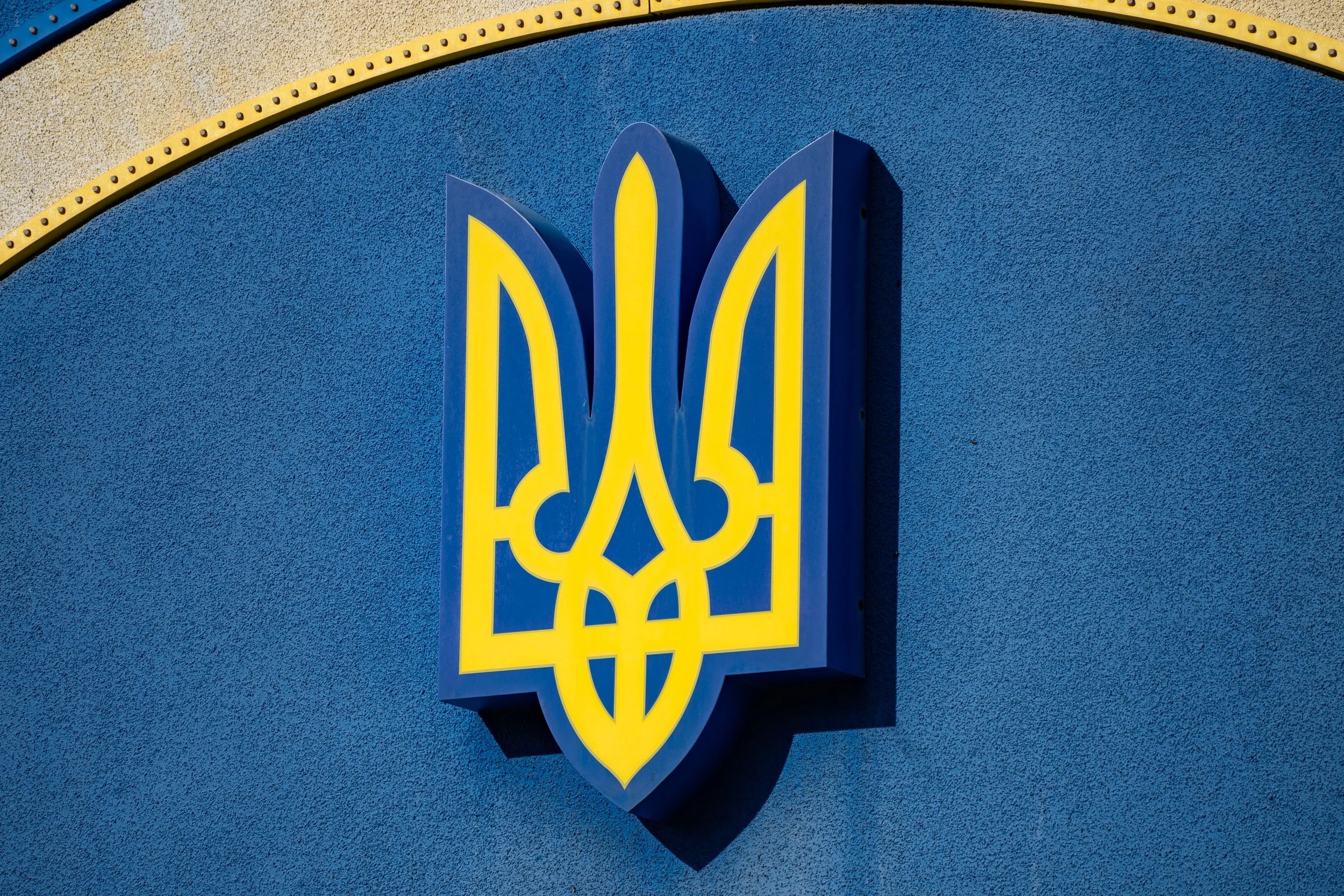
04 October, 2025 - Sumy, Sumy Oblast, Ukraine: A distinctive train shaped building near Sumy train station hosts a bright blue and gold trident on the front of it.
After getting into the train station earlier than expected, I looked for a bench to sit down, but many were covered with tape, probably warning about fresh paint. Many were already seated on them anyway, so I assumed all was well. I got to the last bench on the platform, and it looked good enough, and I pressed my finger against it to see if it was dry. As I did so, a man sat on the other side turned to me and laughed, saying something in Ukrainian. I chuckled too, gathering he was confused by what I was doing. I quickly got google translate open, and we began talking. His wife also stands up, and very soon we’re chatting away, sharing details of our lives, and I ask their names and where they were from. Their names were Volodymyr and Vira, and they lived in a smaller village a short train ride from Sumy. I asked Vira if they were safe and doing well where they lived, and she said, “All good, all good. It happens differently; there are all kinds of military (actions). Russia does not hold back, especially (as) everything happens here in Sumy.” I then asked how they can live under such conditions, and she continued, “We are already used to this and orient ourselves according to the situation. Anxiety also happens at night. We live in a small village in the Sumy region. There are also different circumstances there, and they shoot and shoot down drones all night, too, over which the military flies over our area. Thank god everything is ending. So far, everything is fine. Thank god for all this.”
When I got home and, over the course of a few weeks, got to writing this part, my heart broke reading what Vira said. At the time there there was still some hope that peace talks might progress, but that never materialised. At the end of October, Sumy train station was then struck during a Russian attack, highlighting how random such attacks can happen. Volodymyr and Vira make a living selling white mushrooms in the market in Sumy, and make the trip often, so I sometimes worry about their safety and keep them in my prayers. As we said goodbye to each other so they could make their way to their train, I was overcome with relief at getting such an insightful view of life here in Ukraine during this war, to the point that I had forgotten to take a picture. I picked up my bags as quickly as I could and ran to the other end of the platform. Thankfully, people were slow getting on, and I was able to call out, “Volodymyr, Volodymyr, foto? foto?” and I gestured with my hand. They both smiled and posed together. I shook their hands, and they went on their way, the big diesel train spluttering and rolling like thunder down the track, and just like that, the station was once again quiet. I stood for a moment in that silence, looking at the sky empty of planes, and wondered to myself when this would end. I felt my goal was complete, and, already feeling exhausted, just looked forward to going home.
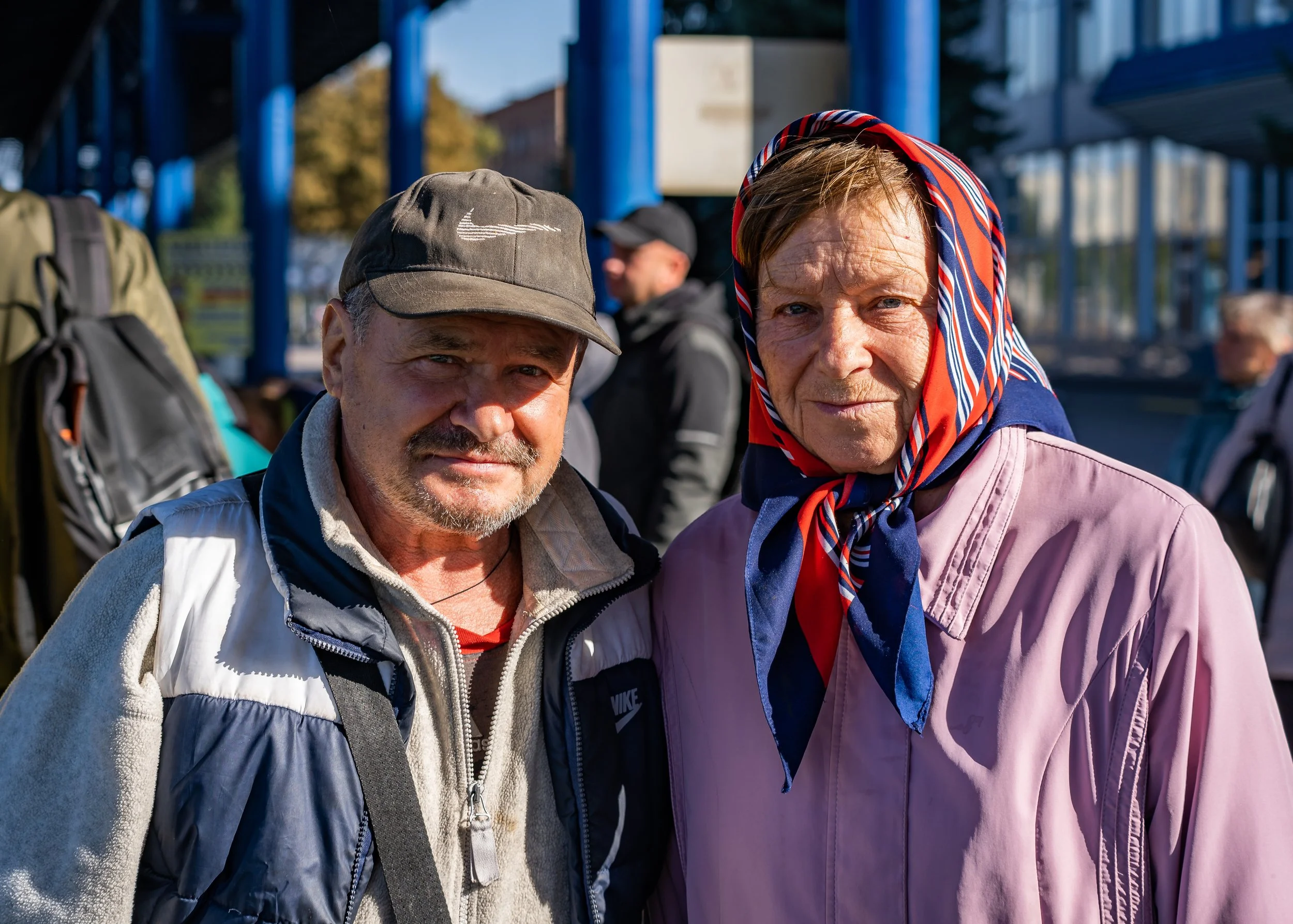
04 October, 2025 - Sumy, Sumy Oblast, Ukraine: Volodomyr and Vira pose for a photo in Sumy train station, before departing to go home to their village.
While waiting for my train to arrive, a big cross-country sleeper, I was looking through the latest updates for the Sumy region, so I was prepared for any issues when I discovered that in Shostka, to the north of Sumy, a train of the same type was hit. The end of one of the passenger carriages was blown to bits, 1 was killed, and 30 were injured. My heart filled with dread, and I felt sick. I knew the chances of such a thing happening were incredibly slim, but the randomness of Russian strikes felt like a death lottery. My respect for those living under these barbaric attacks was immense, but all I wanted to do now was go home. My platform was filling up with travellers, and I saw a soldier with a pistol on his belt embracing a loved one who was crying in his arms. It was heartbreaking, and not the only time I saw it. All I hoped for was that they would be reunited again.
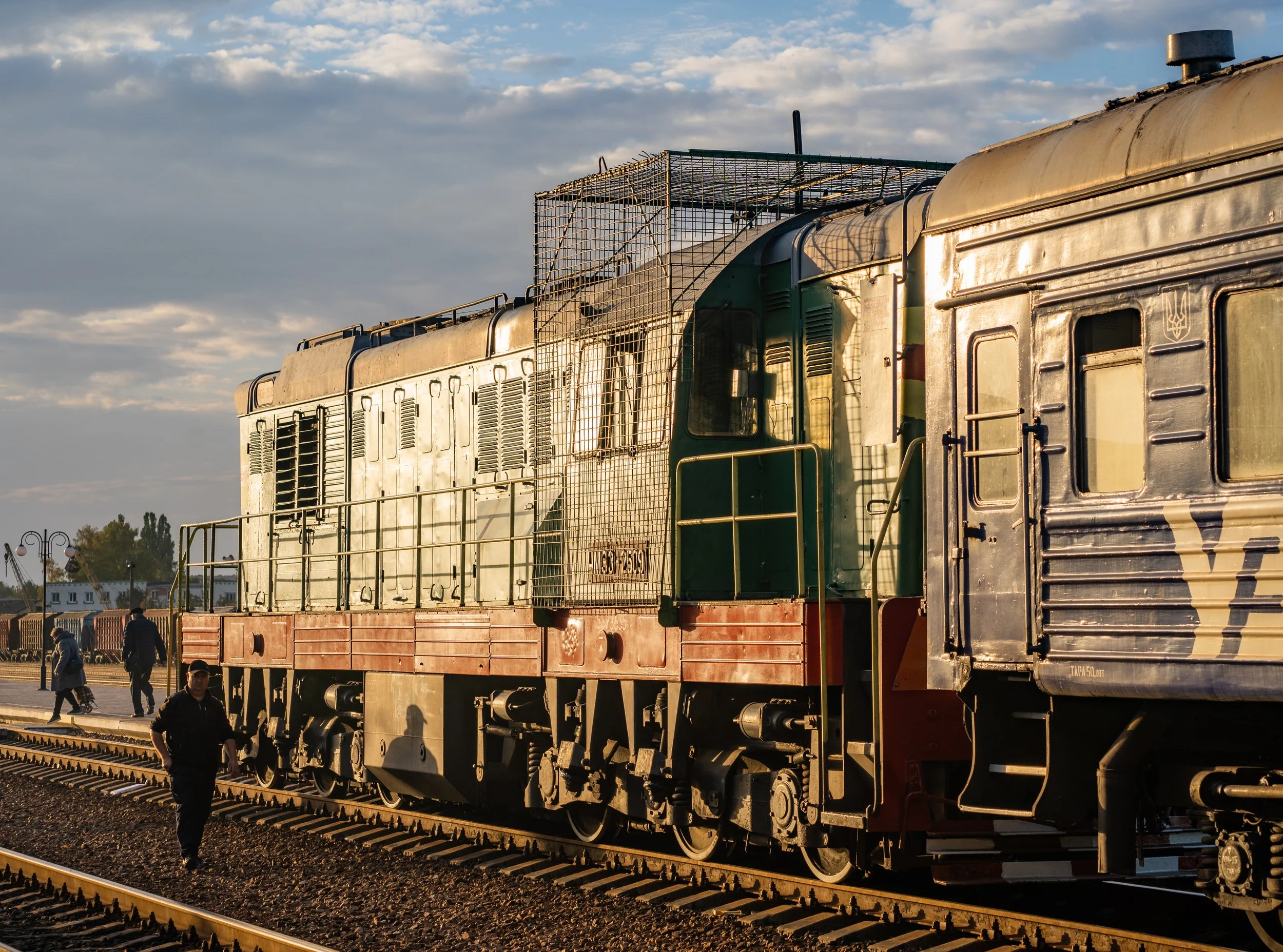
04 October, 2025 - Sumy, Sumy Oblast, Ukraine: One of the trains that passed through the station had an anti drone cage protecting the drivers cab. This was a common feature among military vehicles too.
My train arrived, and I found my cabin; it seemed I was sharing with a soldier. He looked tired, and so was I, so I did not ask any questions. I felt my tasks were accomplished, and the best thing I could do now was get out of the way. During the journey, it was difficult to sleep. The soldier got off somewhere around 5 or 6 in the morning, around the time I woke up and had some snacks to get my energy up. I found out that during this time, Lviv, despite what I had said at the beginning of this story, was suddenly not as safe. During the night, it was struck by a combined drone, cruise missile and ballistic missile attack targeting energy infrastructure. Horrifyingly, four members of one family, including a 15-year-old girl, were killed that night, among many others dead and injured. It was like our train was barreling towards hell. Adam, with whom I had travelled to Ukraine, sent me a video from his hotel in Lviv of the attack, where loud explosions could be heard all night. Those in the hotel spent most of that night in the corridors. I took a look at my phone, counting down every second until getting into Lviv to catch my train to Poland, and it seemed Ukrainian GPS jamming had been turned on in order to confuse the drones, as I was now apparently in northern Chile. Over the next 15 hours, I spent some downtime in Lviv and eventually left Ukraine on a train to Przemyśl and then to Kraków. It was a relief to be back under the umbrella of European security - but all I could think about was that we were not doing enough to help.
Once I was back in the United Kingdom, it took some time to come to terms with who I met and what I saw and heard. On one hand, I was struck by how brave and composed Ukrainians are, going about their daily lives, refusing to live in fear. Their spirit is something we could all learn from. Unfortunately, I came back more with a sense of hopelessness and dread. The continued deterioration of the U.S.-Europe alliance system and the general lack of urgency from world leaders, particularly in Europe, made me feel depressed. The scale of the war, the rates of military production, the things that need to be done in order to keep basic systems online - none of this are we prepared for. What is more concerning is that, in the months that have gone by since I went to Ukraine, it seems ever more clear that Russia holds something over Donald Trump that is capable of making him change his mind every time he picks up a phone call from Vladimir Putin. European leaders have taken note, but done little to prepare for the idea that our closest ally may now be a massive threat to peace in Europe - we have to be extremely careful in these challenging times when one of our greatest allies is calling for a European nation to essentially surrender to an invading force.
I wish I could give a more optimistic view, but I am afraid to say the easy days are now very much behind us, and if not the world, at least us as Europeans, we must prepare for a bleak future. Other superpowers besides Russia are taking note of the inaction over Ukraine, and as U.S. dominance over the world politically and economically shrinks by the day, it's only a matter of time before someone spots a moment of opportunity too good to pass up. Such indecision from our leaders over the last ten years is the very reason we are heading for a darker future. While we keep getting distracted by our TV and smartphones, other nations are preparing mandatory conscription and increasing military spending.
We are completely unprepared - and more concerning, we lack the urgency to care.
Devon to Dnipro: How a small aid group delivers 70 vehicles to Ukraine.
“To actually do something physical and hand over the vehicle to these people, it's actually quite emotional."
The lush green of Stoke Gabriel rolls past the window of our van as we drive down the narrow roadways of the old English town. The topic of conversation is nowhere near as sunny, though - I am with Adam, a group leader of Ukrainian Action Team Devon. This volunteer-run aid group has donated around 70 vehicles to Ukraine since 2022. We are discussing the rare but very real threat of Russian partisans operating against European-based Ukraine assistance, notably when a warehouse full of communications equipment was burnt down in London earlier this year, suspected to be the work of paid saboteurs on behalf of Russia. Whilst the risk is small, Adam is very aware that they could always be a target and takes the safety of his team very seriously.

25 September, 2025 - Stoke Gabriel, Devon, United Kingdom: A Ukrainian Action volunteer goes to check one of the many donated ambulances. Licence plates must be obscured to protect the drivers.
The conversation is cut short, as through the winding roads we are suddenly greeted by a Ukrainian flag at the entrance of a compound like something out of a spy film. This is no lair, however, this is the base of operations for Team Devon - their various vehicles destined for the 2000-mile journey proudly lined up, cleaned, fixed and ready to go. We are some of the first to arrive, but it doesn't take long for the volunteers to start pouring in, their friends and families also coming to see them off. Some are serving coffee, others have camping chairs set up to watch the team do their work. Despite the frantic nature, it is clear this has been done many times before - the team are quick to work, conducting oil, tyre pressure and radio checks, making sure everything is ready for the trip.
In between the various rapid-fire checks and a brief battery scare, I spoke with Phil, team leader of this mission, and asked him how difficult it is to drive second hand, often quite old, vehicles across Europe on such a long trip, "You’ve got to take into account their age, but we take all the vehicles for a very extensive checks - we look a the service history of the vehicles and if there is not a recent service history we will have them fully serviced. We get Kwik Fit to do a full safety inspection of all the tyres - you know, it’s amazing, you look at the vehicles with lovely tread on the tyre, and then you look at the date code on there and it’s 15 years old and starting to perish." I then asked Phil, who has been to Ukraine before and is now on his 10th mission, how it felt knowing he and the team were having a physical impact on the delivery of aid, "We had four work sessions just preparing these vehicles. It's one thing to put some money in the charity, toward a vehicle, but to actually do something physical and hand over the vehicle to these people, it's actually quite emotional."

25 September, 2025 - Stoke Gabriel, Devon, United Kingdom: Phil (Middle) checks over the teams pre-mission briefing notes.
Shortly after speaking with Phil, all the drivers gathered for a final safety briefing and an outline of the route. The key topic is always the safety of the drivers, as even with the second-hand vehicles being fixed up, many still have a lot of miles on them, and there is always a risk of something going wrong. From my time with Ukrainian Action, though, they are very adaptable to these kinds of problems, and it rarely poses an issue. After the final briefing, the volunteer drivers pose for a photo with a British-Ukrainian flag, something of a tradition now with every convoy that departs. With the coffees and teas finished and radios double checked, the drivers say a warm but emotional goodbye to their families. Whilst many won’t be making the full journey into Ukraine, it’s still a long way to Poland to hand them over, and it takes a tremendous amount of work and planning to get them all there together. The convoy departs the compound for a victory lap of the village to much celebration, Ukrainian flags are waving, and people are popping out of their homes and shops to wave goodbye. It’s quite a moving moment to see such a small village come together for a cause significantly bigger and thousands of miles away. Still, that feeling is quickly replaced with the weight of how impressive it is to deliver the number of vehicles that they have. After the lap of the village, the convoy then starts its journey, where I will next meet them in Krakow, Poland, three days later.
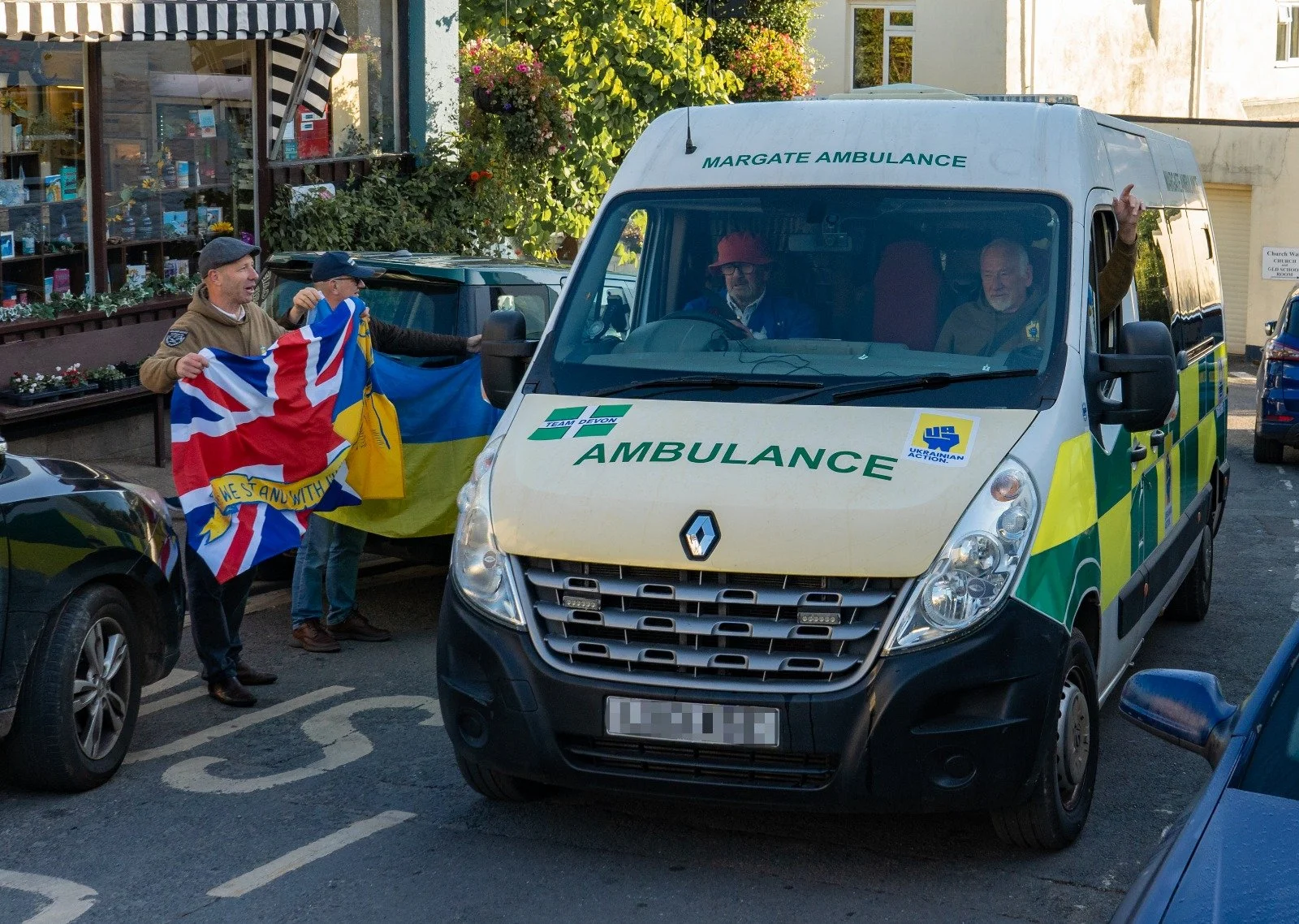
25 September, 2025 - Stoke Gabriel, Devon, United Kingdom: Adam (Left) holds a flag during the teams victory lap of the town, before heading on their long journey to Ukraine. Adam and I would fly to meet them three days later.
Several days and some 1200 miles later, I'm at a sunny petrol station with Adam outside of Krakow airport staring at a Soviet-era missile transporter with a replica Proton rocket mounted on it, wondering why it was there, when a man named Oleg pulls up in a van and ushers us to get in. We are a bit ahead of the convoy, and half an hour later, we pull into a much larger petrol station - and the reason soon becomes clear - as one by one, more and more Ukrainian Action vehicles pull up, and not just the ones from Team Devon, but Team London as well. Nine vehicles in total, all full to the brim with aid. The teams get out and we go to greet them, with only one driver from Team Devon, Brian, staying on until Ukraine with Adam and I, the rest have returned home and swapped with other Polish & Ukrainian volunteers. After further checks of the vehicles, we are once again underway to the border.

28 September, 2025 - Małopolskie Voivodeship, Poland: Oleg (Left) & Adam (Right) watch on as the nine vehicle convoy parks up.
The sun is quickly setting as we cut through the Polish countryside, which, as we get closer and closer, becomes increasingly quiet - one of the many signs of what we are heading into. Among other signs include the city of Rzeszow, which, even if we weren't looking at road signs, the large empty military transport convoys driving away from it remind us of its significant logistical importance for international military aid to Ukraine. Phil had once flown into Rzeszów and had remarked to me on the intense security presence of Patriot surface-to-air missile batteries around the airport to protect it, which stuck with me, given the airspace violation by Russian drones several weeks before this trip. It only emphasised the need for them.

28 September, 2025 - Podkarpackie Voivodeship, Poland: A volunteer secures tarp straps holding donated spare tyres during another quick stop to distribute the weight.
After several hours of driving, and an agonisingly repeating voice yelling "communications battery low, start engine immediately" due to a fault in the dashboard, we arrived at the border with Ukraine. It’s completely dark now, and we're parked on a quiet side road away from the queue, saying goodbye to the 2nd team of drivers who are setting off home. After 20 minutes of discussing what we are going to do for food, as Adam, Brian and myself are already set to arrive late after curfew in Lviv, we are stopped from deciding to go to a nearby McDonald’s when the third and final team of volunteers arrive from the Ukrainian side of the border, crossing on foot, taking a whole six hours to get to us. One by one, like they have done countless times, the volunteers get in their assigned vehicles and we join the queue to the border.
I am now with Maksym, a Ukrainian who, despite being exempted from service, works as a volunteer and has completed this journey several hundred times to get these vehicles and their aid over the border. Maksym struck me as someone very put-together. He spoke softly, yet his quiet determination and meticulous planning for delivering these convoys really stuck with me. All I could do was sit in admiration as he did his pre-border checks. Occasionally, we'd get chatting about politics, but I was mostly invested in watching how he and his team handled the crossing, even despite my crushing tiredness from being awake so long. It took several hours, a lot of paperwork, manifests and waiting around. For them, it was second nature; for us Brits, I was excruciating, but at around 2 am, we finally handed a gate guard a stamped piece of paper, and that was it; we were in Ukraine.
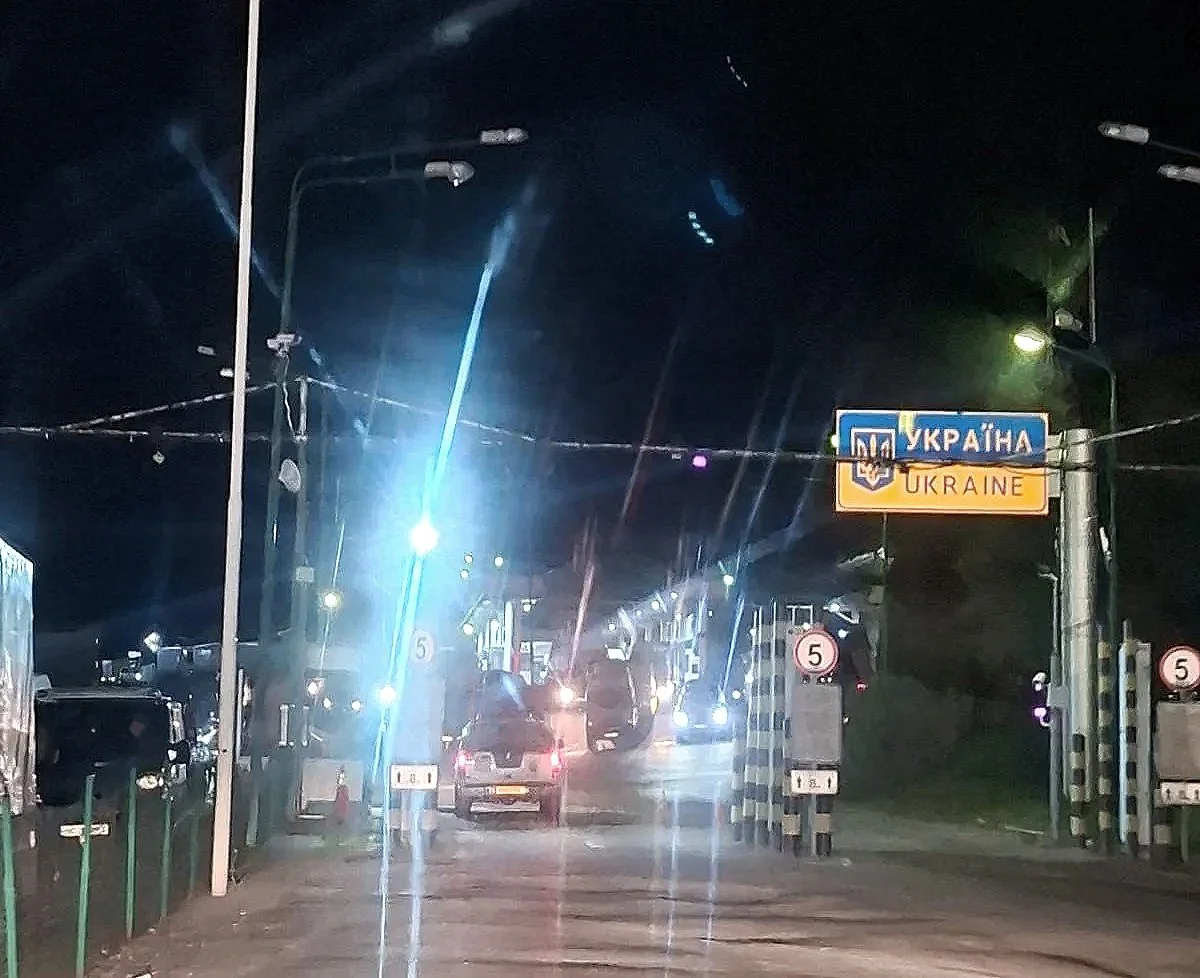
29 September, 2025 - Shehyni Border Checkpoint, Lviv Oblast, Ukraine: A quick photo taken on my phone due to avoid raising suspicion with a chunky DSLR. Last thing I wanted was to be arrested for espionage on my first visit.
After leaving the border station, Maksym and I drove with Adam, Brian and several others to a nearby petrol station. The scenery was now very different, and yet somewhat charming. I stumbled out of the vehicle and gathered some essentials my sleep-deprived mind thought to get: beef jerky and Coca-Cola. The team and I stood in almost near silence in this dim petrol station, chomping on food for about 20 minutes. I think we were all glad to just eat something. Outside, I followed Adam to a small booth to exchange some currency and got my first Ukrainian notes. The girl inside was quiet and seemingly very bored, but I couldn’t blame her; at this time of night, there was little activity here. I soon moved across my bags to yet another donated ambulance, and said goodbye to the Ukrainian volunteers whom I wished I had more time to get to know, and in a less fatigued mood. Adam, Brian and I then set off on the bumpy, winding and dark roads to Lviv. I chuckled to myself as we left the petrol station, as the currency exchange girl was fast asleep with a blanket draped over her. How jealous I was.
I may have been hallucinating at this point, seeing odd light streaks in the trees occasionally separated by large, beautiful churches and the occasional statue of the Virgin Mary staring at me, dimly lit by LED lights, but, eventually we made it into Lviv, and it was time to say goodbye to Adam and Brian, who still had many miles to go. I could not accompany them for the rest of the trip as I would be heading to Kyiv, but Adam, like he has amazingly done several times before, would be making his way across the country to places like Dnipro and eventually Zaporizhzhia to deliver aid and the ambulance itself. I could tell how deeply these trips mean to Adam; he feels profoundly close to the Ukrainian people and has met a great deal of them, and learned many of their experiences. He has also been a tremendous source of help and advice for getting here. I wished him well with a limp wave before slumping through the doors into my hotel. I have never slept so well in my life.
It was a long, long journey, and even longer for Brian and Adam still, but Ukrainian Action impressed me from start to finish. Between the family and friends back in Stoke Gabriel handing out tea and coffee for the drivers, to the final leg volunteers from Ukraine walking six hours over the border just to spend another four crossing back over it again, I was very moved by the groups commitment to supporting Ukraine - it is an emotional thing to see so long into a horrible war, at a time where it is getting less and less attention, while seemingly getting worse and worse, yet they keep going, doing what they do best - action, not words.
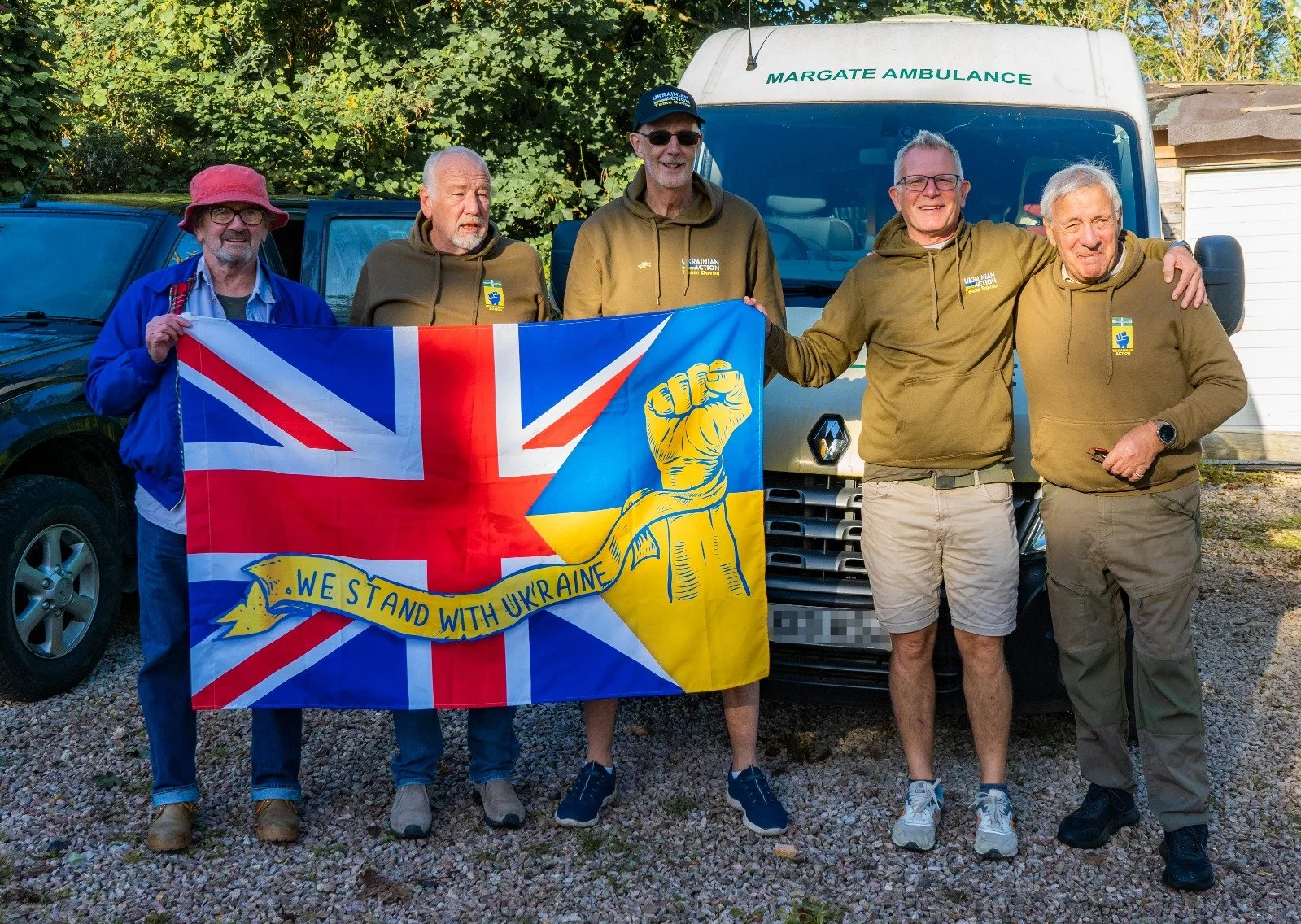
25 September, 2025 - Stoke Gabriel, Devon, United Kingdom: The team of Mission 12 pose for a photo before their journey.